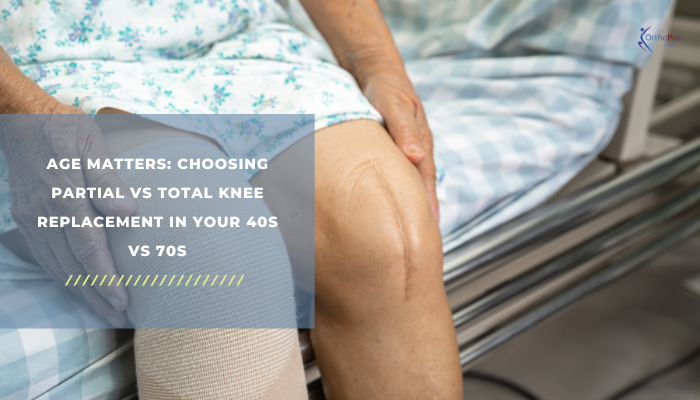
Age Matters: Choosing Partial Vs Total Knee Replacement in Your 40s vs 70s

Age Matters_ Choosing Partial vs Total Knee Replacement in Your 40s vs 70s
Table of Contents
    Add a header to begin generating the table of contents

    Knee pain can significantly limit your daily activities.

    The morning walk that keeps you on track, take the stairs two at a time, or never miss a weekend game. Now these things feel out of reach. 

    When rest, physiotherapy, and injections stop providing relief, knee replacement often comes up. But there is no single “knee replacement.” 

    There are two very different paths, and the right one depends heavily on your age, your activity level, and what you want the next few decades to look like. 

    Getting clarity on partial vs total knee replacement is the first step toward a decision you’ll feel confident about for years.

    What partial and total knee replacement actually mean?

    The knee has three compartments: the inner (medial) side, the outer (lateral) side, and the area behind the kneecap. Damage rarely spreads evenly. That pattern drives the choice.

    • Partial (unicompartmental) knee replacement resurfaces only the one worn compartment, leaving healthy bone, cartilage, and ligaments in place. Incisions are smaller, and recovery tends to be quicker.
    • Total knee replacement resurfaces the entire joint, replacing all worn surfaces. It’s the standard option when arthritis has affected more than one compartment.

    Why your age changes the answer?

    Two people can have almost identical X-rays and still be suited to different surgeries, and age is one of the biggest reasons why. 

    A knee that needs to perform for another 40 years faces very different demands than one that needs to serve comfortably for the next 15 to 20. 

    That’s exactly why the same question, partial vs total knee replacement, frequently has a different answer at 45 than it does at 72.

    Considering partial knee surgery in 40s

    Choosing partial knee surgery in 40s is really a conversation about the long game. Patients in this age group are usually active, working, and nowhere near slowing down, so preserving as much of the natural knee as possible carries real value.

    Why partial knee surgery in 40s appeals to younger patients:

    • Partial knee surgery preserves bone and ligaments, which helps keep future treatment options available.
    • Recovery tends to be quicker, so patients can usually get back to work and daily activities sooner.
    • The knee often feels more natural after surgery, which is important for people who want to stay active or play sports.

    The trade-off is real: younger, more demanding knees place implants under greater stress, and partial replacements carry a somewhat higher chance of revision over time.

    Even so, for many patients a partial acts as a bone-preserving first step that can be converted to a total later if the arthritis spreads.

    Understanding partial knee surgery in 70s

    The math shifts later in life. Weighing partial knee surgery in your 70s usually centers on recovery, safety, and quality of life right now, rather than planning for revisions decades down the road.

    Reasons partial knee surgery in 70s can be a strong fit:

    • A smaller procedure means less blood loss and a gentler recovery, which is valuable if other health conditions are present.
    • Getting mobile sooner reduces the risks associated with prolonged bed rest.
    • A preserved, natural-feeling knee supports confident, independent movement.

    Many surgeons still recommend a total knee replacement for older patients whose arthritis has spread across the joint, since one durable procedure may comfortably last the rest of their lives. 

    The right call always follows the pattern and severity of damage, not age.

    2Age Matters Choosing Partial vs Total Knee Replacement in Your 40s vs 70s

    The cost of partial vs total knee replacement

    Every surgery comes with pros and cons. Knowing the costs of partial and total knee replacements helps you make an informed choice.

    • If you choose a partial knee replacement, you can expect a faster recovery and a knee that feels more natural. However, there is a higher chance you may need additional surgery later if arthritis develops in other parts of the knee.
    • If you choose a total knee replacement, you get a solution that lasts longer. However, this means removing more healthy tissue and undergoing a longer, more difficult recovery.

    For younger patients, choosing a partial knee replacement can help keep future options open. For older patients, a total knee replacement often makes sense as a one-time solution. There is no single right answer. The best choice depends on your body, your goals, and your stage of life.

    Partial vs total knee replacement care from OrthoPro's specialist surgeons

    At OrthoPro Clinic, this decision is never one-size-fits-all. 

    Our orthopedic surgeons are recognized leaders in their sub-specialities, supported by a multidisciplinary team with more than 100 years of combined experience in orthopedics, sports medicine, and rehabilitation. 

    We use advanced diagnostics and offer minimally invasive and regenerative treatments. 

    Every plan is personalized for your knee, your goals, and your stage of life, whether you are a professional athlete or just enjoy staying active on weekends.

    Book your consultation today.

    FAQ's

    What is the best age to have a partial knee replacement?

    There is no single “best” age. Suitability depends far more on the pattern of damage than the number on your birth certificate, the key requirement is that arthritis is confined to one compartment of the knee. Partial knee surgery in 40s can suit active younger patients, while partial knee surgery in 70s can offer a gentler recovery for older ones. A specialist assessment and imaging confirm whether you’re a candidate.

    What is better, partial knee replacement or total knee replacement?

    Neither is universally better, it comes down to how much of the joint is worn. When arthritis affects only one compartment, a partial offers a faster recovery and a more natural-feeling knee. When damage is widespread, a total is the more durable choice. The right decision in partial vs total knee replacement is always personalized to your knee and your goals.

    Should a 70 year old have a knee replacement?

    Age alone is rarely a barrier. Many people in their 70s do extremely well with surgery, and the decision rests on your pain levels, mobility, and overall health rather than your age. Depending on the extent of the arthritis, both partial and total options may be on the table.

    Is it a good idea to get a partial knee replacement?

    For the right candidate, someone with arthritis limited to a single compartment, a partial knee replacement can be an excellent option, offering quicker recovery, less bone loss, and a natural feel. The main consideration is a somewhat higher chance of further surgery if arthritis later develops in another part of the knee. A specialist can confirm whether it’s the smart move for you.

    Our Recent Blogs..