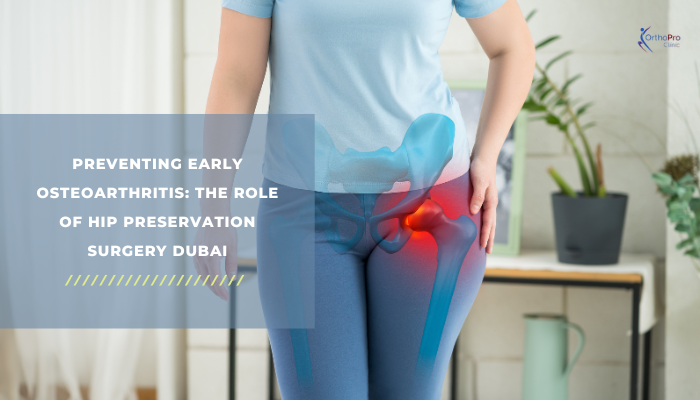
Preventing Early Osteoarthritis: The Role of Hip Preservation Surgery Dubai

1Preventing Early Osteoarthritis_ The Role of Hip Preservation Surgery Dubai by Orthoproclinic
Table of Contents
    Add a header to begin generating the table of contents

    Hip pain in a younger or active person does not always mean that arthritis has already developed. Sometimes, the pain comes from a structural problem in the hip that, if left untreated, can gradually damage the cartilage and increase the risk of early osteoarthritis.

    At OrthoPro Clinic, the focus is on identifying these problems as early as possible and understanding whether the natural hip can be protected. Hip preservation surgery Dubai may be appropriate for carefully selected patients when conditions such as hip impingement, labral tears, dysplasia or certain cartilage problems begin affecting the joint.

    Quick Facts

    • Hip preservation aims to maintain the natural hip and potentially delay the progression of joint damage.
    • Common problems include femoroacetabular impingement, hip dysplasia, labral tears and selected cartilage injuries.
    • Not everyone with hip pain requires surgery.
    • Early assessment is particularly valuable when symptoms are persistent or repeatedly return with activity.

    What is Osteoarthritis?

    Osteoarthritis is a gradual breakdown of the smooth cartilage that cushions the ends of the bones inside a joint. As the cartilage becomes thinner or damaged, the bones can begin to rub more closely, leading to pain, stiffness and reduced movement. In the hip, osteoarthritis can make everyday activities such as walking, climbing stairs or getting in and out of a car increasingly uncomfortable.

    Why can a hip problem lead to early Osteoarthritis?

    The hip is a ball-and-socket joint. The rounded head of the thigh bone fits into the socket of the pelvis, with smooth cartilage covering the joint surfaces so they can move with minimal friction. A strong ring of tissue called the labrum also helps deepen the socket and stabilise the joint.

    Problems can occur when the bones do not fit or move together normally. With femoroacetabular impingement (FAI), for example, extra bone or an abnormal shape can cause repeated contact between the ball and socket. Over time, this may injure the labrum and cartilage.

    With hip dysplasia, the socket may be too shallow to adequately cover the femoral head. This can place increased pressure on a smaller area of cartilage and potentially contribute to earlier joint deterioration.

    Other conditions, including certain cartilage injuries and avascular necrosis, can also compromise the health of the hip. The important point is that hip osteoarthritis can sometimes be the result of an underlying problem that developed years earlier.

    Early, moderate or advanced: Why the stage of damage matters?

    Hip preservation is generally considered before severe arthritis has developed. The exact condition of the cartilage, bone and joint space is more important than age alone.

    Stage

    What may be happening

    What preservation may involve

    Pre-arthritic

    Structural problems such as impingement or dysplasia may exist without significant cartilage loss

    Addressing the underlying abnormality may help protect the joint

    Early osteoarthritis

    Early cartilage wear or mild joint-space changes may be present

    Selected patients may still benefit from joint-preserving treatment

    Moderate osteoarthritis

    More cartilage damage and increasing stiffness may develop

    Suitability depends on the remaining cartilage and the underlying cause

    Advanced osteoarthritis

    Significant cartilage loss, joint-space narrowing and functional limitation occur

    Preservation becomes less predictable, and joint replacement may be considered

    This does not mean that every patient follows these stages in exactly the same way. A detailed clinical assessment and appropriate imaging are needed to understand the condition of an individual hip.

    11Preventing Early Osteoarthritis_ The Role of Hip Preservation Surgery Dubai by Orthoproclinic

    Important to Know

    Hip preservation is not a guarantee that osteoarthritis will never develop. Its purpose is to correct or manage certain problems that may be contributing to joint damage and, in appropriate patients, potentially delay further deterioration.

    Which hip problems may need attention?

    Different conditions can place the natural hip under abnormal stress.

    Femoroacetabular impingement: Abnormal contact between the hip bones can irritate the labrum and cartilage, particularly during deep bending or rotation.

    Hip dysplasia: A shallow socket provides less coverage of the femoral head and can increase pressure on the joint.

    Labral tear: Damage to the labrum may cause groin pain, clicking, catching or discomfort during movement.

    Avascular necrosis: Reduced blood supply to the femoral head can cause bone damage and, in some cases, collapse of the joint surface.

    Cartilage damage: Injury or repeated stress can affect the smooth surface that allows the hip to move freely.

    Not every structural abnormality causes symptoms, and not every painful hip requires an operation. The decision depends on the combination of symptoms, examination findings, imaging and the condition of the joint.

    What might tell you that something is wrong?

    Hip problems can be surprisingly easy to overlook, particularly when symptoms come and go.

    You may notice:

    • Pain in the groin, hip or sometimes the thigh
    • Pain during running, squatting or twisting
    • Clicking, catching or a feeling that the hip is locking
    • Reduced hip flexibility
    • Difficulty sitting for long periods
    • Pain when getting in or out of a car

    Pain that repeatedly returns despite rest deserves attention, particularly if it is beginning to limit everyday activities.

    Patient Tip

    Before your appointment, note when the pain occurs, which movements aggravate it and whether you experience clicking, catching or stiffness. This can give your specialist useful information about how the hip is behaving during everyday activities.

    How is hip preservation planned?

    Treatment starts with finding out what is actually causing the problem. Your orthopaedic specialist may ask about previous injuries, sports, activity levels, the location of your pain and movements that make your symptoms worse.

    A physical examination can assess hip movement, strength, stability and areas of tenderness. Imaging may then be used to examine the bones and soft tissues more closely. Depending on the suspected condition, this may include X-rays, MRI or other specialised imaging.

    At OrthoPro Clinic, treatment planning should be based on the individual hip rather than simply the presence of pain. Factors such as cartilage health, joint structure, age, activity level and the extent of existing arthritis all matter.

    Which treatments can help preserve the natural hip?

    Treatment is not automatically surgical. Depending on the underlying condition and its severity, several approaches may be considered.

    • Physical therapy: Targeted exercises can improve hip strength, movement and muscular control while helping reduce unnecessary stress on the joint.
    • Activity modification: Temporarily changing activities that repeatedly aggravate the hip may reduce symptoms while the underlying condition is assessed and treated.
    • Hip arthroscopy: A minimally invasive procedure using a small camera and specialised instruments to treat selected problems inside the hip, including certain labral, impingement and cartilage conditions.
    • Labral repair: When a torn labrum is suitable for repair, the damaged tissue may be repaired to help restore the stability and function of the hip.
    • Femoroacetabular impingement correction: Excess or abnormally shaped bone contributing to impingement may be reshaped to improve the way the ball and socket move together.
    • Periacetabular osteotomy: In selected patients with hip dysplasia, the socket can be repositioned to improve coverage of the femoral head and distribute forces more effectively across the joint.
    • Cartilage restoration: Certain focal cartilage defects may be treated using techniques such as microfracture or osteochondral procedures, depending on the location, size and severity of the damage.
    • Surgical hip dislocation: A more extensive approach that provides access to the hip joint and may be considered for complex structural abnormalities that cannot be adequately addressed through less invasive techniques.


    The appropriate option depends entirely on the patient’s diagnosis and the condition of the joint. 


    111Preventing Early Osteoarthritis_ The Role of Hip Preservation Surgery Dubai by Orthoproclinic

    Can hip preservation prevent a hip replacement?

    In some patients, treating an underlying hip problem early may delay the need for a hip replacement. However, it cannot guarantee that replacement will never be necessary.

    The long-term outlook depends on factors such as existing cartilage damage, the original hip condition, age, activity level and how the joint responds to treatment. Patients with advanced cartilage loss generally have fewer joint-preserving options than those treated before substantial arthritis develops.

    Understanding hip preservation surgery Dubai cost

    The hip preservation surgery Dubai cost varies from patient to patient. It may depend on the diagnosis, imaging required, surgical technique, hospital and anaesthesia requirements, and the rehabilitation needed afterwards.

    Rather than relying on a general price, a specialist assessment can establish whether surgery is actually necessary and provide a more meaningful estimate based on the proposed treatment.

    Protecting the hip before damage becomes advanced

    Early osteoarthritis is not always inevitable. When an underlying structural problem is identified before substantial cartilage loss occurs, there may be an opportunity to treat the cause and preserve the natural hip for longer.

    At OrthoPro Clinic, patients can discuss their symptoms, imaging findings and treatment options with an orthopaedic specialist to understand whether hip preservation surgery Dubai is appropriate for their individual condition.

    Book your consultation today. 

    FAQ's

    Who is a candidate for hip preservation surgery Dubai?

    Hip preservation surgery Dubai may be considered for selected patients with problems such as hip impingement, dysplasia, labral tears or certain cartilage injuries, particularly when there is still meaningful healthy cartilage in the joint.

    Is hip preservation surgery Dubai suitable if I already have osteoarthritis?

    It may be an option for some patients with early arthritis, depending on the cause and amount of cartilage damage. Advanced osteoarthritis generally makes joint-preserving surgery less suitable.

    What determines the hip preservation surgery Dubai cost?

    The Hip preservation surgery Dubai cost depends on the underlying condition, investigations, procedure required, hospital and anaesthesia costs, and rehabilitation. An individual assessment is needed for an accurate estimate.

    Does hip preservation mean I will never need a hip replacement?

    No. Hip preservation may delay replacement in appropriately selected patients, but it cannot guarantee that arthritis will not progress. The condition of the cartilage and the underlying cause are important factors in determining the long-term outlook.

    Our Recent Blogs..