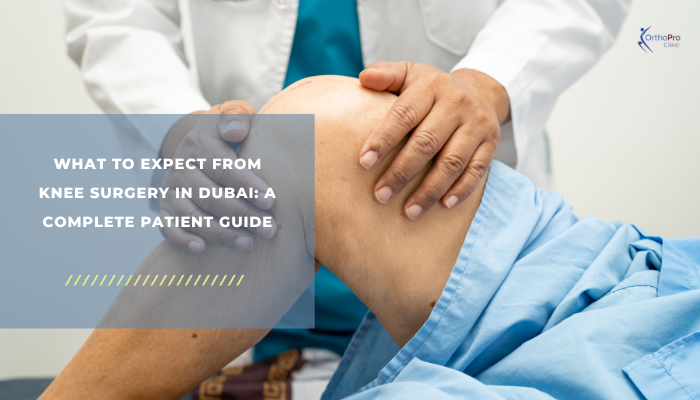
What to Expect from Knee Surgery in Dubai: A Complete Patient Guide

2What to Expect from Knee Surgery in Dubai_ A Complete Patient Guide by orthoproclinic
Table of Contents
    Add a header to begin generating the table of contents

    Knee surgery can feel like a major decision, especially when you do not know what the procedure involves or how long recovery might take. The first thing to understand is that knee surgery in Dubai is not one single operation. The right procedure depends on what has damaged the knee, how severe the problem is, and how much it is affecting your movement and daily life.

    At OrthoPro Clinic, knee care is provided by orthopedic specialists with expertise across knee, sports medicine, and joint replacement. The clinic combines orthopedic assessment with advanced imaging, surgical expertise, and rehabilitation support, allowing treatment to be planned around the individual rather than using the same approach for every patient.

    What is knee surgery?

    Knee surgery is an operation performed to repair, treat, or replace damaged structures in or around the knee joint. Injuries to the ACL or meniscus, cartilage damage, and advanced arthritis that has meaningfully impacted the joint are all situations where this may be recommended. 

    Surgery is not automatically the first treatment for knee pain. Your orthopaedic specialist will often explore a range of options first, depending on the diagnosis, this may include physiotherapy, activity modification, injections, or other non-surgical approaches. Surgery becomes a consideration when the underlying problem is unlikely to improve sufficiently with conservative care or when structural damage is significantly affecting function.

    The procedure can range from minimally invasive arthroscopy to partial or total knee replacement.

    222What to Expect from Knee Surgery in Dubai_ A Complete Patient Guide by orthoproclinic

    The main types include:

    Knee arthroscopy: Uses a small camera and specialized instruments through small incisions to diagnose or treat selected problems inside the joint.

    ACL reconstruction: Reconstructs a torn anterior cruciate ligament when instability and the patient’s activity requirements make surgery appropriate.

    Meniscus treatment: A damaged meniscus may sometimes be repaired or treated surgically, depending on the tear.

    Partial knee replacement: Replaces only the damaged compartment while preserving healthier parts of the knee.

    Total knee replacement: Replaces damaged joint surfaces when arthritis or other severe joint damage affects a larger part of the knee.

    Robotic-assisted knee replacement: Uses computer-assisted technology to help with surgical planning and implant positioning in appropriate patients.

    How do you know if surgery is right for you?

    The decision is based on more than an X-ray or MRI. Your orthopedic surgeon will consider:

    • Your symptoms and how long they have been present
    • The extent and location of joint damage
    • Knee stability, movement, and strength
    • Your age, general health, and activity level
    • Previous treatments and how well they worked
    • How the knee problem affects work, exercise, sleep, and everyday activities
    • Your expectations and recovery goals

    For example, an active patient with an isolated ACL injury may have very different surgical needs from someone with advanced osteoarthritis affecting several areas of the knee.

    Important to Know: A recommendation for knee surgery does not necessarily mean knee replacement. The goal is to choose the least invasive treatment that can appropriately address the underlying problem.

    What happens before knee surgery?

    Your preparation starts with a detailed orthopedic assessment. Your doctor will examine the knee and review relevant imaging, which may include X-rays or MRI depending on the suspected condition.

    At OrthoPro Clinic, an Advanced Imaging Centre provides MRI, digital X-ray, ultrasound, and DEXA scanning facilities, supporting diagnosis and treatment planning.

    Before surgery, your care team may also:

    1. Review your medical history and current medications.
    2. Assess your general fitness for surgery and anesthesia.
    3. Explain the proposed procedure and expected outcome.
    4. Discuss potential risks and alternatives.
    5. Give you instructions about preparation before the operation.
    6. Explain what rehabilitation is likely to involve afterward.

    This is also the right time to ask practical questions, such as when you can walk, drive, return to work, exercise, or climb stairs.

    What happens during and immediately after surgery?

    The surgical process varies considerably depending on the procedure. During a knee replacement, damaged joint surfaces are removed and replaced with artificial components. In selected cases, robotic technology can assist the surgeon with planning and positioning.

    After surgery, you will be monitored while the effects of anesthesia wear off. Pain control, safe movement, wound care, and prevention of complications become the immediate priorities. Following knee replacement, rehabilitation and knee exercises generally begin early to help restore movement and strength.

    What is knee surgery recovery like?

    Recovery depends heavily on the procedure. Someone undergoing arthroscopy may have a different timeline from someone recovering from total knee replacement.

    After knee replacement, recovery commonly progresses in stages:

    First few days:
    Pain, swelling, stiffness, and difficulty walking are common. You may initially need crutches, a walker, or another walking aid.

    First few weeks:
    Walking and everyday movement gradually become easier. Physiotherapy focuses on improving knee movement, strength, balance, and confidence.

    Following months:
    Strength and function continue to improve. Some swelling or discomfort can persist for several months, even as normal activities gradually return.

    22What to Expect from Knee Surgery in Dubai_ A Complete Patient Guide by orthoproclinic

    What can help your recovery?

    • Follow your surgeon’s and physiotherapist’s instructions.
    • Complete your recommended exercises consistently.
    • Increase activity gradually rather than pushing through excessive pain.
    • Keep the surgical wound clean and follow wound-care instructions.
    • Use walking aids until your care team says they are no longer necessary.
    • Attend follow-up appointments.

    Recovery is not a race. The aim is steady improvement while allowing the tissues to heal properly.

    When should you contact your doctor?

    Some pain and swelling are expected after surgery, but worsening symptoms should not simply be ignored.

    Seek prompt medical advice if you notice:

    • Increasing redness, warmth, swelling, or drainage around the wound
    • Persistent fever or chills
    • Increasing pain that is not settling
    • New or worsening calf pain or swelling
    • Sudden difficulty bearing weight
    • Chest pain or sudden shortness of breath

    These symptoms can have different causes, but they require appropriate medical assessment.

    What can affect the Knee Replacement Dubai Cost?

    The knee replacement Dubai cost is not the same for every patient. It can vary according to whether you need a partial or total replacement, the complexity of your condition, implant selection, hospital and anesthesia charges, investigations, and rehabilitation requirements.

    Why choose OrthoPro Clinic for knee care?

    Choosing a knee clinic should involve more than looking for a surgical procedure. Good outcomes depend on accurate diagnosis, appropriate treatment selection, experienced orthopedic care, and structured rehabilitation.

    OrthoPro Clinic brings these elements together through:

    • Dedicated orthopedic and subspecialist care
    • Advanced on-site imaging facilities
    • Knee and joint replacement expertise
    • Robotic-assisted joint replacement services
    • Physiotherapy and sports-performance support
    • A multidisciplinary approach extending from diagnosis through rehabilitation

    The clinic also works in collaboration with the top most and leading hospital groups for surgical care, helping provide a coordinated pathway when surgery is required.

    Making an informed decision about knee surgery

    Taking the time to think carefully about knee surgery is always the right approach , it is not a decision that should ever feel rushed or pressured. Understanding your diagnosis, treatment alternatives, expected recovery, and rehabilitation plan can make the process much clearer.

    If knee pain or limited movement is affecting your quality of life, OrthoPro Clinic can assess the underlying problem and discuss whether surgical or non-surgical treatment is appropriate for you. 

    Book your personalized orthopedic consultation to understand your options for knee surgery in Dubai.

    FAQ's

    How do I find the best orthopedic surgeon in Dubai for knee surgery?

    Look for relevant knee subspecialty experience, appropriate surgical expertise, access to accurate imaging, and a clear rehabilitation plan. The right surgeon should also explain why a particular procedure is suitable for your condition.

    What is the knee replacement Dubai cost?

    The type of replacement, implant, hospital and anesthesia requirements, necessary investigations, and rehabilitation all play a role in determining the overall cost. A personalized assessment is needed for an accurate estimate.

    How long does it take to recover from knee surgery?

    It depends on the procedure. After arthroscopy, recovery can be relatively brief, but knee replacement is a different story, often taking several months before strength, movement, and function are where they need to be.

    Is robotic knee replacement suitable for everyone?

    No. Robotic assistance may be useful for selected partial or total knee replacement procedures, but suitability depends on your diagnosis, anatomy, and surgical requirements.

    When should I consider knee surgery in Dubai?

    If non-surgical treatments have not done enough to address persistent pain, instability, stiffness, or functional limitations caused by structural knee damage, surgery may be considered.

    Our Recent Blogs..