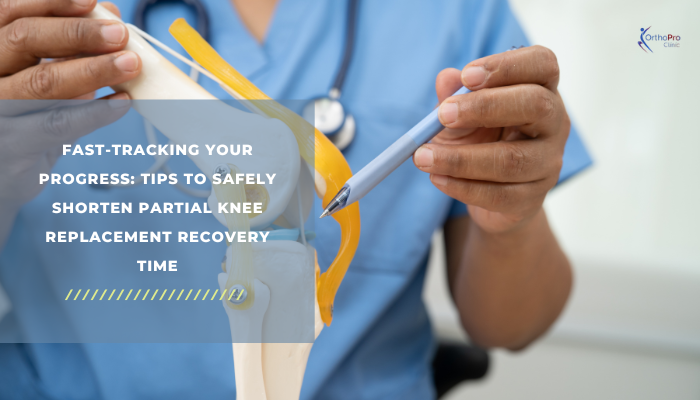
Fast-tracking your progress: Tips to safely shorten partial knee replacement recovery time
Someone who has localized osteoarthritis or unicompartmental joint damage may be a good candidate for partial knee replacement surgery. This procedure does not involve removing healthy cartilage, bone, and important ligaments, such as the anterior cruciate ligament (ACL), like a full joint replacement does.
Consequently, the partial knee replacement recovery time is significantly shorter and involves less tissue disruption. The patient-centered approach here at OrthoPro Clinic ensures a structured approach that will help you to recover comfort, stability, and mobility in a seamless manner.
Knowing what to expect and what steps to take along the way to recovery helps a patient to move forward with their rehab with confidence. While individual factors such as age, overall physical fitness, and adherence to physical therapy influence your overall partial knee replacement recovery time, applying evidence-based recovery strategies can safely accelerate your progress.Â
With specific post-operative guidelines, pain management strategies, and other steps to avoid common pitfalls, it is possible to make the best of joint function and ensure that your new implant lasts as long as possible.
Factors influencing partial knee replacement recovery time
The healing of the joints varies among patients. By knowing the critical factors that affect recovery from a partial knee replacement, you can set the proper expectations and make your journey to recovery safer:
- Pre-operative mobility and muscular strength in the quadriceps and hamstring groups.
- Overall health, including controlled blood sugar levels and cardiovascular wellbeing.
- Surgical technique, including minimally invasive approaches that reduce soft tissue disruption.
- Consistency in attending recommended physical therapy sessions and performing prescribed home exercises.
- Effective management of localized post-operative inflammation and discomfort.
Essential tips to safely shorten partial knee replacement recovery time
After undergoing partial knee surgery, a speedy recovery depends on consistency and following medical advice. The main idea behind fast-tracking progress is to optimize all aspects of physical rehabilitation, rather than rushing the process.
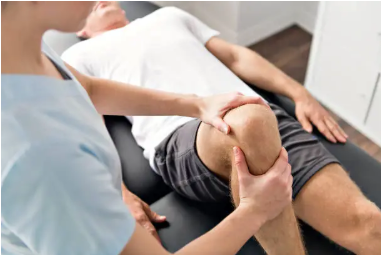
Early mobilization is a basic measure. Early gentle movement of the leg after surgery is important for good circulation, muscle activation and reducing the risk of deep vein thrombosis. Under the supervision of a physical therapist, starting short, regular walks using a walker or cane aids in restoring natural gait mechanics without placing undue stress on the surgical site.
Doing an individualized exercise program is also very important. Strengthening exercises for the quadriceps muscle and restoration of knee flexion (bending) and extension (straightening) are performed daily in the home to maintain knee mobility. Slowly building up walking time weekly helps maintain heart health and joint strength.
Managing pain and inflammation effectively
Good control of pain and swelling is essential to maintaining a good rehabilitation program. Swelling that is uncontrolled will limit the range of motion in the joints and also make physical therapy exercises more difficult. Prescribed multi-modal pain management medication with non-pharmacological methods forms an ideal setting for tissue healing.
The cold therapy packs are used several times a day for 15 to 20 minutes to alleviate tenderness in the surgical site and reduce localized swelling. Rest is also important, and having an active exercise session followed by adequate restorative rest helps to avoid overload of the joints and enables surrounding muscles to recover well.
![]()
Key recovery milestones to keep in mind
Monitoring your progress through the important post-operative stages gives clear objectives and reassurance throughout the recovery process::
- Weeks 1 to 2: Incision healing, assistive device (adaptive) weight bearing, initial knee extension and early post-surgical swelling management.
- Weeks 3 to 4: Walking with a single cane, knee bent to 90 degree angles, and being able to do light daily activities on their own.
- Weeks 5 to 6: Walking for moderate distance independently, resume driving when surgeon considers it safe and return to work at the desk.
- Weeks 7 to 12: Engaging in low-impact physical activities such as stationary cycling or swimming, with continued strength progression under clinical guidance.
Navigating your recovery following unicompartmental joint surgery does not have to be an overwhelming process. While every patient heals at their own pace, taking an active, informed role in your rehabilitation significantly optimizes your overall partial knee replacement recovery time.Â
You set the stage for mobility and comfort by focusing on early supervised mobility, adhering to the carefully designed physical therapy plan, using anti-inflammatory therapies to curb swelling following the surgery, and taking precautions to protect your knee joint when getting dressed.
Safe recovery is not only about passing through the milestones quickly or ignoring the body’s signals, it’s about creating the joint strength and stability that takes time to build up day by day. When you follow the evidence-based guidelines for post surgery, your joint will operate smoothly and less pain will be associated with it, along with less time spent in stiffness.
Request a consultation at OrthoPro Clinic
If you are preparing for joint surgery or seeking guidance on how to safely manage your partial knee replacement recovery time, the clinical team at OrthoPro Clinic is here to support your journey. Our orthopaedic specialists provide tailored rehabilitation strategies designed around your specific recovery goals and daily lifestyle needs.
Â
To schedule a personalized evaluation or learn more about our comprehensive post-surgical care plans, visit OrthoPro Clinic today or contact our patient support center to book an appointment with an orthopaedic consultant.
FAQ's
Is recovery time quicker for a partial knee replacement?
Yes, the time to recover from partial knee replacement is typically shorter than the time to recover from total knee replacement. The surgeon only replaces the damaged compartment while leaving the healthy bone, cartilage and ligaments in place, which means that there is less trauma to the surgery, less blood loss and a faster return to natural knee motion.
How can I speed up my recovery after partial knee replacement?
You can optimize your partial knee replacement recovery time by starting early physical therapy exercises, staying consistent with daily home exercises, managing pain and swelling with ice and rest, walking short distances frequently, and strictly following the guidance of your care team at OrthoPro Clinic.
Will elevating my leg speed up my partial knee replacement recovery time?
Absolutely, raising the leg above the level of the heart helps decrease fluid accumulation and swelling around the knee joint area after surgery. Reducing swelling will make the joints less stiff and painful, enabling physical therapy exercises to be done more easily, and thus facilitating a smooth partial knee replacement recovery time.
What are the five mistakes people make after knee replacement?
The five big mistakes made during the recovery period from a knee injury are to ignore surgeon-prescribed exercise, ignore pain, ignore leg elevation and icing, not follow wound care instructions, and return to high-impact activities or driving without surgeon clearance.
Our Recent Blogs..
Fast-tracking your progress: Tips to safely shorten partial knee replacement...Read More
Age Matters: Choosing Partial Vs Total Knee Replacement in Your...Read More
Why a specialized Podiatry Chair is the true backbone of...Read More
What Is the Difference Between Podiatry and Chiropody? Table of...Read More
Robotic Knee Replacement: Faster Recovery for Osteoarthritis Knee Treatment in...Read More
How the Climate in Dubai Impacts Your Osteoarthritis Knee Treatment...Read More
Knee Gel Injections: which is best for your Osteoarthritis knee...Read More
5 signs you might need Shoulder Arthroscopy for your pain...Read More
Visible Symptoms of a Torn Meniscus: Swelling, Bruising, and Knee...Read More
Why Does My Elbow Hurt When I Bend or Straighten...Read More