


Anterior Hip Replacement: Benefits and Recovery
Joint pain can be debilitating, impacting every aspect of your life – from daily tasks to pursuing your passions.
If you’re struggling with chronic hip pain, you’ve likely explored numerous options, and perhaps, the idea of hip replacement has emerged.
Among the various surgical approaches, Anterior Hip Replacement stands out as a revolutionary technique with distinct advantages for many patients.
Why Choose Anterior Hip Replacement? Understanding the Benefits
A minimally invasive procedure called an anterior hip replacement allows the surgeon to access the hip joint without separating the muscles of the femur or pelvis by creating an incision at the front of the hip. One of the main reasons for its attraction is the preservation of muscles and tendons.
The following are a few noteworthy advantages of anterior hip replacement:
- Reduced muscle damage: Less muscle cutting or detaching is implied by the anterior technique, which operates between preexisting muscle planes in contrast to conventional posterior or lateral procedures.
- Quick recovery: Patients return to their regular activities more quickly and with less post-operative pain when there is less muscle disturbance. For people who are keen to get back on their feet, this is a huge benefit.
- Reduced risk of dislocation: Because the posterior hip capsule and muscles are preserved, the risk of hip dislocation after anterior hip replacement is significantly reduced. This offers greater peace of mind during recovery.
- Smaller incision: The anterior approach typically involves a smaller incision, leading to a more cosmetically appealing scar.
- Less pain: Many patients report less pain in the initial post-operative period compared to other approaches due to the muscle-sparing nature of the surgery.
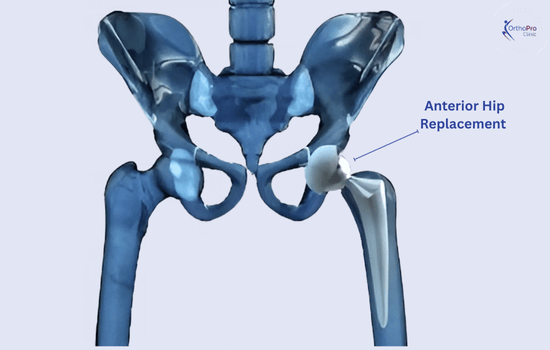
What are the disadvantages of anterior hip replacement?
Even while there are many advantages, it’s equally critical to be aware of any potential drawbacks and factors related to anterior hip replacement. There are some risks associated with every surgical treatment, so it’s important to be completely informed.
Disadvantages include:
- Learning curve for surgeons: The anterior approach is technically demanding and requires specialized training and experience.
- Potential for nerve injury: While rare, there’s a small risk of temporary or long-term nerve damage, particularly to the lateral femoral cutaneous nerve, which can cause numbness in the thigh.
- Fracture risk during surgery: There’s a slightly higher risk of femur fracture during the procedure with the anterior approach, though experienced surgeons can significantly mitigate this.
- Limited exposure in complex cases: For very complex or revision hip replacement cases, the anterior approach might offer less surgical exposure compared to traditional methods.
It’s important to have an open and honest discussion with your surgeon about these potential downsides. Our team at OrthoPro Clinic will ensure you have a complete understanding of the risks and benefits, addressing any concerns you may have about anterior hip replacement.
Where is the incision for anterior hip replacement?
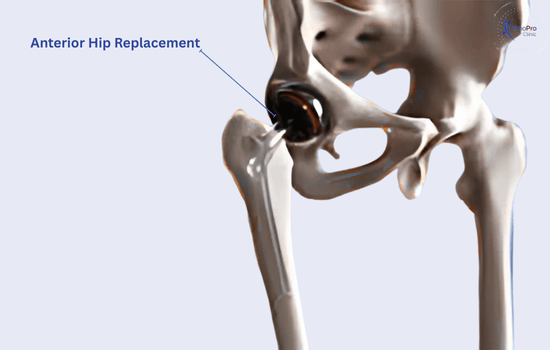
A common question patients have regarding anterior hip replacement is about the incision. As the name suggests, the incision for anterior hip replacement is made on the front (anterior) aspect of your hip, typically in the groin crease or slightly below it.
This placement enables the surgeon to access the hip joint by working between muscles rather than cutting through them. The length of the incision may vary depending on the patient’s anatomy and the surgeon’s preference, but it is generally smaller than incisions used in traditional hip replacement surgeries.
The location of the incision for anterior hip replacement is a major reason for the faster recovery times and reduced pain experienced by many patients.
Anterior hip replacement recovery week by week guide: What to expect
One of the most appealing aspects of anterior hip replacement is the expedited recovery process. While individual recovery times vary, here’s a general week-by-week guide to what you might expect after Anterior Hip Replacement:
- Week 1:
- You’ll likely be discharged from the hospital within 1-3 days.
- Pain management is a priority, and you’ll be prescribed medication.
- You’ll begin light walking with the aid of crutches or a walker.
- Physical therapy will start, focusing on gentle range-of-motion exercises.
- You’ll be encouraged to get up and move frequently to prevent stiffness.
- Weeks 2-6:
- You’ll gradually increase your walking distance and reduce reliance on assistive devices.
- Physical therapy will become more intensive, focusing on strengthening exercises.
- You’ll be able to perform most daily activities with greater ease.
- Driving may be possible, depending on your recovery and the affected hip.
- Weeks 7-12:
- Most patients are walking without assistance and returning to light activities.
- Strengthening exercises will continue to build endurance and stability.
- You may be cleared to return to work, depending on your job’s physical demands.
- Beyond 12 weeks:
- Full recovery can take anywhere from 3-6 months, and sometimes longer, depending on individual factors.
- You’ll continue to progress with your strength and mobility.
- Many patients are able to return to sports and more vigorous activities, as advised by their surgeon and physical therapist.
Positions to avoid after anterior hip replacement
While anterior hip replacement offers a lower risk of dislocation compared to traditional approaches, it’s still crucial to be mindful of certain movements and positions during your initial recovery.
Your surgeon and physical therapist will provide specific guidelines, but generally, you should be cautious about:
- Excessive external rotation: Avoid extreme outward turning of your leg, especially when lying down.
- Combined external rotation and extension: This combination can put stress on the hip joint.
- Lying on your side without support: Initially, it’s often recommended to sleep on your back with a pillow between your knees if you must lie on your side.
- Extreme hip extension: Avoid extending your leg far behind you.
Compared to posterior approaches, the list of positions to avoid after anterior hip replacement is significantly shorter and less restrictive, allowing for greater freedom of movement during recovery. Our team at OrthoPro Clinic will provide clear, detailed instructions on positions to avoid after anterior hip replacement to ensure a safe and successful recovery.
Visit OrthoPro Clinic for Expert Care
At OrthoPro Clinic in Dubai, we are a one-stop destination for joint pain diagnostics, management, and treatments, all under one roof, and our world-class super-specialist orthopaedic surgeons for spine are experts in performing this advanced procedure.
We combine cutting-edge technology with the compassionate care of world-class super-specialist orthopaedic surgeons. We are dedicated to delivering reliable Orthopaedic & Sports Medicine care, ensuring you receive the best possible outcome for your anterior hip replacement.
Book an appointment with OrthoPro Clinic.
Fast-tracking your progress: Tips to safely shorten partial knee replacement...Read More
Age Matters: Choosing Partial Vs Total Knee Replacement in Your...Read More

Why a specialized Podiatry Chair is the true backbone of...Read More

What Is the Difference Between Podiatry and Chiropody? Table of...Read More
Robotic Knee Replacement: Faster Recovery for Osteoarthritis Knee Treatment in...Read More

How the Climate in Dubai Impacts Your Osteoarthritis Knee Treatment...Read More

Knee Gel Injections: which is best for your Osteoarthritis knee...Read More

5 signs you might need Shoulder Arthroscopy for your pain...Read More

Visible Symptoms of a Torn Meniscus: Swelling, Bruising, and Knee...Read More

Why Does My Elbow Hurt When I Bend or Straighten...Read More