


Are you an active individual who suddenly finds your hip isn’t functioning properly? Maybe it’s that lingering discomfort while tying your shoes, a deep ache after sitting too long, or a stabbing pain during workouts or sports. These aren’t just signs of getting older or “overdoing”, they could point to a condition known as hip impingement.
Also called femoroacetabular impingement (FAI), this condition affects people of all ages, particularly athletes, fitness enthusiasts, and young adults. The sooner it’s identified, the better your chances of preserving hip function and staying pain-free.
In this blog, we will explore the details of hip impingement, what hip impingement syndrome is, its causes, diagnosis, and treatment modalities.
What Is Hip Impingement Syndrome?
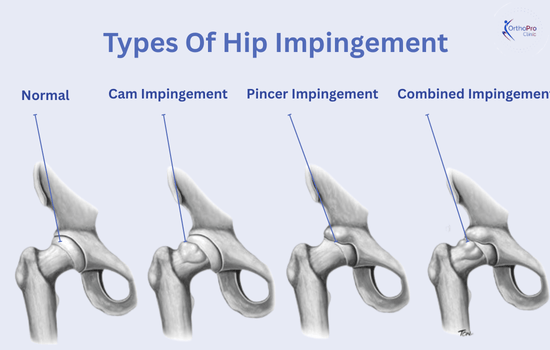
Hip impingement Syndrome happens when the bones of the hip joint, namely, the femoral head (thigh bone) and acetabulum (hip socket) misfit together. With repeated movement, these bones can rub against each other, damaging the joint’s cartilage or labrum over time. This leads to stiffness, inflammation, and pain.
Early hip impingement symptoms often start with a dull ache in the groin or hip area that worsens with physical activity.
There are two main types of FAI:
- Cam Impingement: Extra bone develops along the femoral head, making it less round and more likely to grind against the socket.
- Pincer Impingement: The socket extends too far, covering too much of the femoral head and leading to pinching.
- Combined Impingement: A mix of both cam and pincer types.
What Does an Impinged Hip Feel Like?
Chronic hip inflammation can result from repeated joint irritation, often seen in conditions like impingement or bursitis.
The symptoms of hip impingement often build gradually. You might feel:
- A deep, aching pain in the front of your hip or groin, especially during or after movement.
- Reduced flexibility when it feels harder to squat, lunge, or rotate the leg.
- A clicking or catching sensation inside the joint.
- Sharp pain when sitting for long periods or standing.
- Difficulty walking uphill or climbing stairs.
In the early stages, the symptoms may be mild or inconsistent. However, left untreated, FAI can progress and increase the risk of labral tears or early arthritis.
What Causes Hip Impingement?
Hip impingement typically develops in adolescence or early adulthood, especially in people whose hip joints didn’t form normally during growth. It’s also seen more frequently in athletes who participate in high-impact or repetitive motion sports like football, hockey, or dance.
Common hip impingement causes include abnormal bone development during growth or repetitive stress from sports and daily activities.
However, it can affect anyone, even those with no athletic background.
Factors that may contribute include:
- Structural abnormalities of the hip bones
- Repetitive stress or overuse
- Genetic predisposition
- Previous hip injuries
While you cannot always prevent hip impingement, early recognition of the warning signs can help you avoid long-term joint damage.
How Is Hip Impingement Diagnosed?
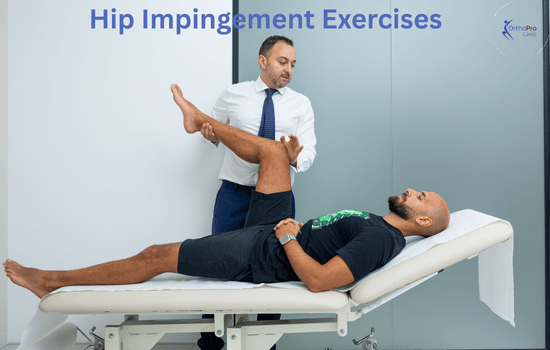
Diagnosis begins with a physical examination, where your doctor may perform a hip impingement test, gently rotating and flexing your hip to reproduce symptoms. If this suggests FAI, imaging such as X-rays, MRI, or CT scan is often recommended to assess bone shape and look for cartilage damage or labral tears.
It’s also important to rule out other conditions that may mimic FAI symptoms, such as:
- Hip bursitis
- Labral tears without impingement
- Groin strains
- Osteoarthritis
- Referred pain from the lower back
Can Hip Impingement Heal on Its Own?
People often wonder, ‘Does hip impingement go away on its own?
In reality, hip impingement is a structural condition, so the bony abnormalities do not reverse on their own. However, mild cases can be managed without surgery through conservative measures that reduce inflammation and improve joint mechanics.
Hip Impingement Treatment Options
1. Conservative Treatment
Most people start with non-surgical options, especially in the early stages:
- Activity modification: Avoiding deep squats, sitting for prolonged periods, or high-impact exercise.
- Physiotherapy: Specialised hip impingement exercises focus on improving hip mobility, core stability, and muscle strength.
- Anti-inflammatory medication: Helps ease pain and swelling.
- Injections: Corticosteroid or platelet-rich plasma (PRP) injections may be considered in some cases.
2. Surgical Treatment
When conservative treatments fail to bring relief, hip impingement surgery via arthroscopy can help reshape the joint and reduce further damage.
The surgeon reshapes the bones, repairs torn cartilage, and improves joint alignment. This can significantly relieve pain and restore range of motion.
What to Expect After Hip Impingement Surgery
Hip impingement surgery recovery can take several months, depending on the extent of the repair and your commitment to rehab.
Recovery varies by individual and the extent of the procedure. Typically:
- Crutches may be needed for a few weeks.
- A rehabilitation programme begins soon after surgery, guided by a physiotherapist.
- Most people return to regular activity within three to six months, with full recovery potentially taking up to a year.
Following your post-operative plan closely is crucial to a smooth and successful recovery.
Hip Impingement Exercises That Can Help
Under the guidance of a physiotherapist, targeted exercises can improve hip strength and flexibility, such as:
- Hip flexor and quadriceps stretches
- Glute activation drills
- Core strengthening
- Low-impact activities like swimming or cycling
Always avoid self-diagnosing or starting exercises without professional input; what works for one person may aggravate symptoms in another.
Reclaim Your Mobility with Expert Care at OrthoPro Clinic
Hip impingement doesn’t have to dictate how you move, live, or exercise. The key is early recognition, proper diagnosis, and a personalised treatment plan.
OrthoPro Clinic combines cutting-edge orthopaedic expertise with compassionate care to help reclaim mobility.
Whether you’re an athlete or simply want to walk pain-free again, OrthoPro is here to guide your recovery every step of the way.
Don’t let hip pain hold you back; take the first step towards freedom of movement with OrthoPro Clinic.
Request a call back today!
Preparing for Your Scan: Metal Checklists and Protocols for an...Read More
Diet Vs. Reality: Tracking True Fat Loss Milestones with a...Read More
Fast-tracking your progress: Tips to safely shorten partial knee replacement...Read More
Age Matters: Choosing Partial Vs Total Knee Replacement in Your...Read More
Why a specialized Podiatry Chair is the true backbone of...Read More
What Is the Difference Between Podiatry and Chiropody? Table of...Read More
Robotic Knee Replacement: Faster Recovery for Osteoarthritis Knee Treatment in...Read More
How the Climate in Dubai Impacts Your Osteoarthritis Knee Treatment...Read More
Knee Gel Injections: which is best for your Osteoarthritis knee...Read More
5 signs you might need Shoulder Arthroscopy for your pain...Read More