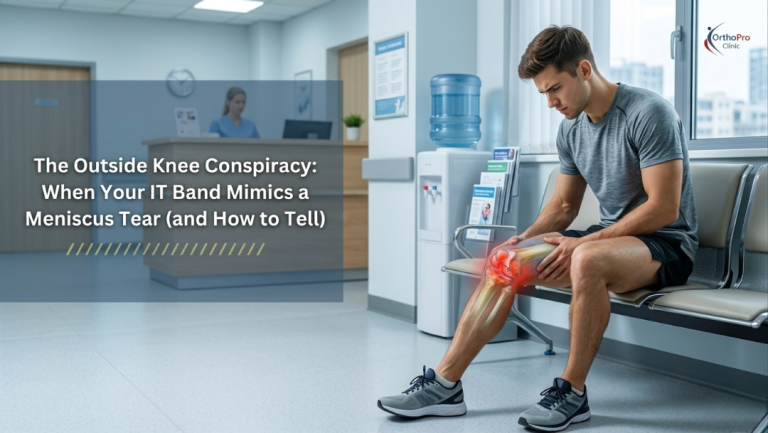
The Outside Knee Conspiracy: When Your IT Band Mimics a Meniscus Tear (and How to Tell)
Outer knee pain can be unsettling. One day, it feels like a mild ache. The next day, every step reminds you that something is wrong. You may notice sharp pain on the outside of your knee, discomfort while climbing stairs, or stiffness after sitting too long. It is natural to worry about a meniscus tear. The symptoms can feel serious.
But what if the problem is not inside the joint at all?
In many active individuals, the real cause is irritation of the iliotibial band, a condition that closely imitates meniscus pain. This confusion often leads to unnecessary anxiety and, at times, delayed recovery. The overlap in symptoms can make it difficult to tell the difference without a proper assessment.
At OrthoPro, we frequently see patients who believe they have a meniscus tear. After a detailed assessment of the entire lower limb, including the hip, knee, and walking mechanics, we find that the problem lies in the iliotibial band. With accurate diagnosis and structured treatment plans, we help patients recover safely from iliotibial band syndrome and return to movement with confidence.
Let us break this down clearly.
What is the Iliotibial Band?
The Iliotibial Band (IT band) is a thick band of connective tissue. It runs from the outer hip down to the outside of the knee. It helps stabilize the knee during walking, running, and climbing.
When this band becomes tight or inflamed, it rubs against the outer knee. This causes iliotibial band syndrome, commonly called IT Band Syndrome.
It is one of the most common causes of lateral (outer) knee pain in runners and cyclists. Studies suggest that IT band issues account for up to 12% of running-related knee injuries.
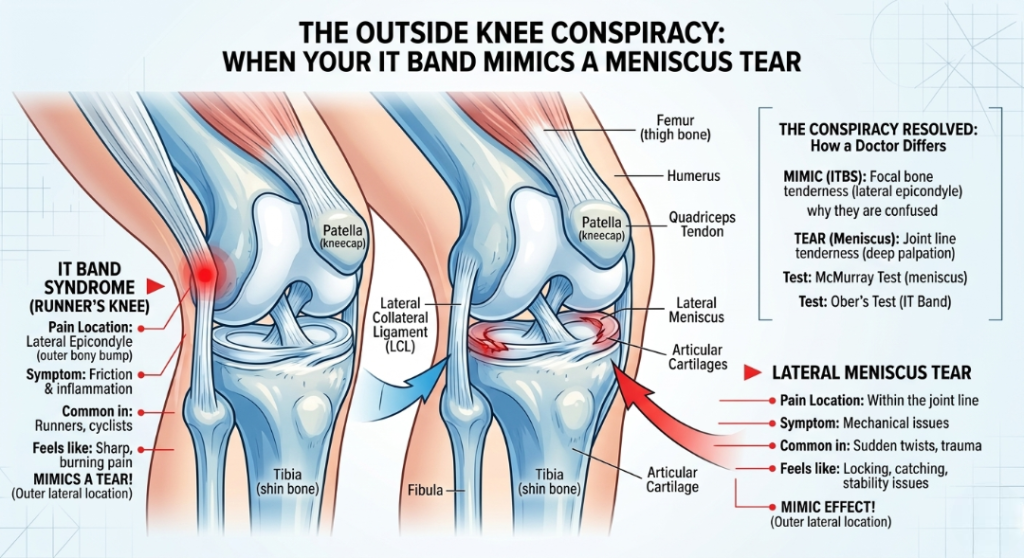
Why IT band syndrome feels like a meniscus tear?
The outer knee is a crowded area. The IT band crosses the joint line – the same region where the meniscus sits.
When the IT band becomes irritated, the pain is sharp and localized.
Patients say:
- It clicks
- It locks sometimes
- It hurts when I bend
- It band syndrome hurts to walk
These symptoms overlap with meniscus injuries. Without proper evaluation, confusion is common.
This is the “outside knee conspiracy.”
IT band syndrome symptoms
Recognizing patterns helps.
Common IT band syndrome symptoms include:
- Sharp or burning pain on the outer knee
- Pain that worsens with running downhill
- Discomfort after prolonged walking
- Tenderness when pressing the outside of the knee
- Tightness along the outer thigh
- Pain radiating upward toward the hip
In many patients, the issue does not start in the knee. It starts in the hip.
The IT band syndrome hip connection
Weak hip abductors and tight hip muscles increase tension along the IT band. When hip mechanics are poor, the knee absorbs extra stress.
This is why addressing the hip is critical. Treating only the knee gives temporary relief.
IT Band vs Meniscus Tear
Below is a clear comparison to help you understand the difference:
Feature | IT Band Syndrome | Meniscus Tear |
Pain Location | Outer side of knee | Inner or outer joint line |
Onset | Gradual, linked to overuse | Often sudden twist or injury |
Swelling | Minimal | Common |
Locking | Rare | Common in larger tears |
Pain Pattern | Worse with repetitive movement | Pain with deep bending or twisting |
Tenderness | Along outer thigh and knee | Directly at joint line |
Imaging | MRI often normal | Tear visible on MRI |
Treatment | Physiotherapy and stretching | May require surgery |
This comparison is helpful. But diagnosis must always be clinical and imaging-supported when needed.
What causes IT band syndrome?
Several factors contribute:
- Sudden increase in training intensity
- Running on sloped surfaces
- Weak hip stabilizers
- Tight quadriceps and hamstrings
- Poor footwear
- Leg length differences
It is rarely caused by an it band tear. True tears are uncommon. Most cases involve inflammation and friction.
Why IT band syndrome hurts to walk?
In early stages, pain appears only during running. As irritation increases, even walking triggers discomfort.
The condition occurs as every step bends and straightens the knee. The IT band repeatedly rubs over the lateral femoral condyle. With inflammation present, friction becomes painful.
Ignoring symptoms makes the cycle even worse.
IT band syndrome treatment
The good news: most cases respond well to conservative care.
At OrthoPro, we follow a structured plan:
- Activity modification
Reduce aggravating movements for the time being. Complete rest is rarely needed. Controlled reduction proves to be effective.
- Ice and anti-inflammatory measures
These reduce irritation in the early phase.
- IT band stretches
Gentle, consistent stretching reduces tension along the lateral thigh.
Examples of effective it band stretches include:
- Standing cross-leg stretch
- Supine strap stretch
- Side-lean wall stretch
Stretches must be slow and sustained. Quick bouncing makes symptoms worse.
- IT band syndrome exercises
Strengthening is more important than stretching.
Effective it band syndrome exercises include:
- Side-lying leg raises
- Clamshells
- Monster walks with resistance bands
- Single-leg bridges
- Hip abduction strengthening
These correct hip weakness. Strong hips reduce strain on the IT band.
- IT band syndrome physical therapy
Structured IT physiotherapy is the foundation of recovery.
Professional IT band syndrome PT focuses on:
- Gait correction
- Hip stabilization
- Core strengthening
- Biomechanical assessment
- Gradual return-to-sport planning
Research shows that targeted hip strengthening significantly reduces recurrence rates in runners.
- Advanced options
If pain persists:
- Corticosteroid injections may reduce inflammation
- Shockwave therapy may stimulate healing
- Rarely, surgical release is considered
Surgery is uncommon and reserved for chronic, resistant cases.
When it is actually a meniscus tear?
While many outer knee pains are IT band related, true meniscus tears do occur.
Red flags include:
- Sudden twisting injury
- Significant swelling within 24 hours
- Knee locking that prevents full extension
- Persistent instability
In these cases, MRI imaging is helpful. Early diagnosis prevents long-term joint damage.
How OrthoPro makes the right diagnosis?
Accurate diagnosis requires:
- Detailed history
- Specific physical tests
- Functional movement assessment
- Imaging only when necessary
At OrthoPro, we evaluate the entire kinetic chain – hip, knee, ankle alignment. We do not treat just the painful spot. We identify the root cause.
This prevents unnecessary procedures.
Recovery timeline
Most patients improve within 4 to 8 weeks with consistent physiotherapy. Athletes often return to sport gradually.
Remember, rushing recovery increases recurrence risk.
Preventing IT band syndrome
Prevention is possible.
Key strategies include:
- Regular hip strengthening
- Proper warm-up
- Gradual mileage progression
- Avoiding sudden terrain changes
- Replacing worn-out shoes
- Including weekly it band stretches
Preventive programs reduce overuse injuries by up to 30% in recreational runners.
The emotional side of knee pain
Knee pain affects more than mobility. It impacts confidence.
When it band syndrome hurts to walk, patients fear long-term damage. They avoid activity. Fitness declines. Understanding the real cause brings relief. Knowing that surgery is often unnecessary reduces anxiety.
Hence, staying informed and aware is important.
Do not let the outside knee conspiracy fool you
Deal with iliotibial band syndrome with professional help and precise diagnosis at OrthoPro
Do not let persistent outer knee pain mislead you into assuming the worst. What feels like a serious internal injury, can be a sign of iliotibial band syndrome. This can respond well to the right care. The key is accurate diagnosis and a structured treatment plan tailored to your movement pattern.
At OrthoPro, our specialists focus on identifying the true source of pain and guiding you through targeted rehabilitation that restores strength, balance, and confidence. If your knee discomfort is limiting your daily life or athletic goals, seek professional evaluation and take the first step toward lasting recovery.
Book a comprehensive evaluation at OrthoPro today.
Our Recent Blogs..
Knee Gel Injections: which is best for your Osteoarthritis knee...Read More
5 signs you might need Shoulder Arthroscopy for your pain...Read More
Visible Symptoms of a Torn Meniscus: Swelling, Bruising, and Knee...Read More
Why Does My Elbow Hurt When I Bend or Straighten...Read More
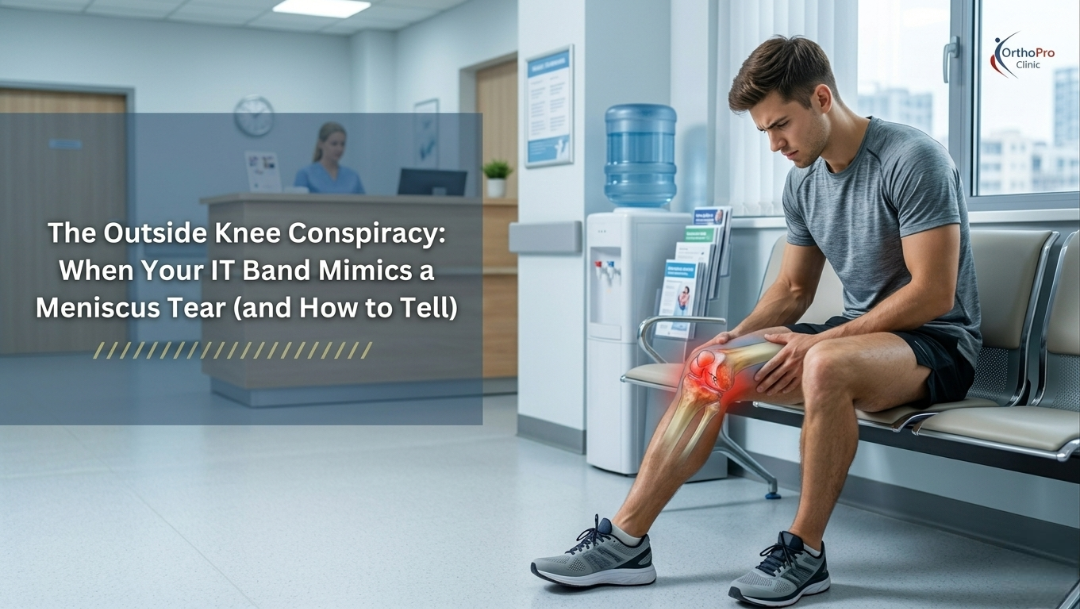
The Outside Knee Conspiracy: When Your IT Band Mimics a...Read More

Repairing the Soft Spot: How to Stop Chondromalacia Before it...Read More
The Hidden Crack: Why Your Persistent Joint Pain Might Be...Read More
Chronic Pubalgia Diagnosis: The “No-Bulge” Hernia That Conventional Scans Often...Read More
Back Pain Only at Night: Is it your Sleep Position,...Read More
When Your Back Only Hurts at Night: Understanding Nocturnal Back...Read More